
With AI development, shipping fast is easy. Shipping right is the hard part.
Across industries, AI is a topic of daily business conversations — what it can do, what it will change, and how to make the most of it. At Creed Interactive, we’re no different. We use it to accelerate client-approved development, automate pieces of QA, and experiment with end-to-end AI-enabled product delivery in our innovation lab. The tools are remarkable, the pace is real, and the productivity gains are genuine.
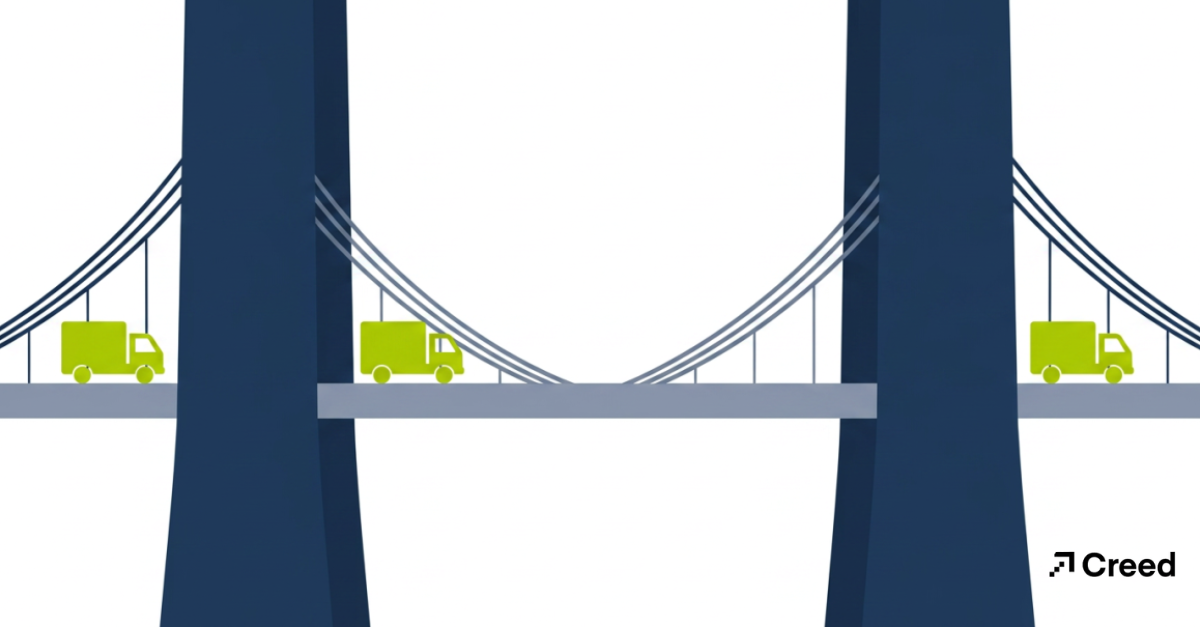
But after more than two decades helping companies build software products that actually hold up, we’ve noticed something interesting: AI has dramatically accelerated the middle 60% of software development.
Give AI a clear requirement and a well-defined task, and it can generate code, write tests, document functionality, and help move work forward faster than ever before.
The harder parts sit on either side of that work.
The first 20%: Discovery and direction
Most projects that struggle don’t struggle because of bad execution. They struggle because the foundation wasn’t right. The wrong problem got prioritized. Requirements were vague. The team chose a tool because it was trending, not because it fit. And by the time those decisions surface as problems, months of momentum are already tied to them.
This is where we start. Before any code gets written, we work alongside product owners and leadership to facilitate discovery, helping to get clarity on what you’re building, who it’s for, and what success actually looks like. We document requirements that translate cleanly into development and build roadmaps grounded in real constraints.
We also do something many engagements skip: we architect the project to work with AI, not just alongside it. That means establishing the right context structures so AI tools have what they need to be genuinely useful, defining code and architectural patterns that keep the solution coherent as it grows, and putting guardrails in place that prevent the drift that derails so many AI-assisted builds. A well-structured foundation isn’t just good engineering, it’s what makes AI a reliable accelerator instead of a liability.
The AI landscape moves fast. We keep up with it so you don’t have to start from scratch every time a new model drops.
The middle 60%: Keeping momentum
Here’s something most folks won’t say out loud: internal product owners have a day job. Strategic initiatives stall not because teams lack capability, but because the people driving them get pulled in ten directions at once. Alignment slips. Decisions pile up. Momentum dies quietly, and nobody notices until the timeline is already underwater.
We offer ongoing project alignment support that keeps things moving when internal bandwidth runs thin. It’s not micromanagement and it’s not hand-holding. It’s a senior product partner who knows your roadmap, can facilitate decisions, and makes sure the build keeps moving in the right direction. The AI handles the heavy lifting in the middle. We make sure the direction stays right.
The last 20%: From working to production-ready
A working prototype and a production-ready product are two very different things, and the gap between them is where projects stall, budgets expand, and launches slip.
Security vulnerabilities don’t announce themselves. Scalability issues surface at the worst possible moment. Integrations that worked in staging behave differently under real load. Things like deployment pipelines, performance tuning, accessibility compliance, and break-fix cycles are not optional if people are depending on what you’re building. Teams that skip this phase don’t avoid the work. They just pay for it later, at a higher cost and usually at a moment of maximum inconvenience.
We’ve helped teams who built something great but couldn’t get it across the line. Getting to production-ready isn’t glamorous, but it’s what separates software that ships from software that sits.