
What leadership needs to hear before approving a digital investment

Building the internal business case for a digital overhaul
You know something needs to change. Maybe your team is duct-taping three disconnected systems together just to produce a weekly report. Maybe your website is bleeding leads. You’ve done the research, maybe even gotten a proposal you were excited about, and then you took it upstairs and watched the momentum drain out of the room.
“Can we do this next fiscal year?” “What’s the ROI on this, exactly?”
In our experience at Creed, the most common reason a digital project stalls isn’t budget. It’s that the champion, often the Marketing Manager, IT Director, or Digital Lead who sees the problem most clearly, doesn’t yet have the language to make it land with the people who hold the keys.
This isn’t uncommon, but can prove challenging. So, we spoke with a few of our most successful client partners who offered the following tips to help change the conversation.
Translate symptoms into business outcomes
Executives aren’t thinking about symptoms. They’re thinking about risk, return, and strategic priority. So before you build a single slide, run every problem through this exercise: ask “so what?” until you reach a business outcome.
- Our website is outdated. → Visitors leave before converting. → We’re losing qualified leads to competitors. → Preventable revenue loss.
- Our portal is clunky. → Members call support instead of self-serving. → Cost-to-serve is inflated and retention is at risk. → Excess operational cost.
- Our systems don’t integrate. → Staff spend hours on manual data entry. → That’s headcount cost with no strategic return. → Unnecessary labor and a team operating below its potential.
This reframe alone will change how the conversation goes.
Build the ROI on four levers
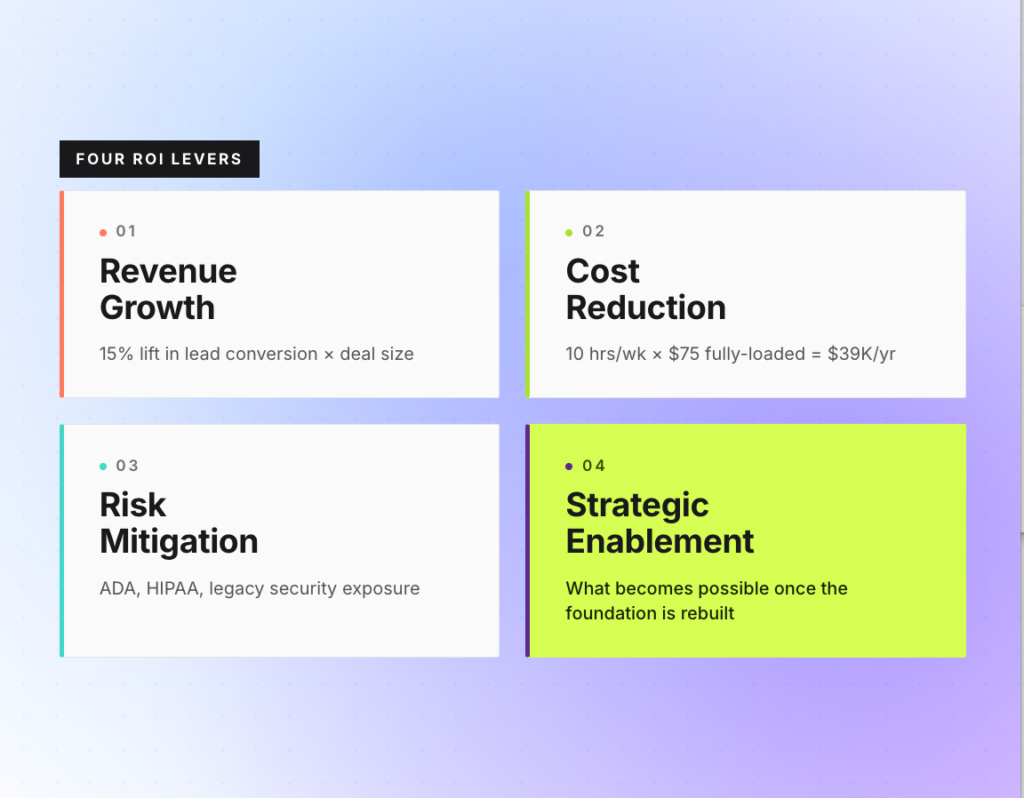
You don’t need a finance degree. You need a structure. When we help clients think through a digital investment, we use four value levers:
- Revenue growth. What’s a 15% improvement in lead conversion worth at your average deal size? Run the math conservatively.
- Cost reduction. If your team spends 10 hours/week on manual workarounds at a $75 fully loaded hourly rate, that’s $39,000/year in labor you’re paying for inefficiency. Name it.
- Risk mitigation. ADA litigation, HIPAA exposure, security vulnerabilities in legacy platforms; these aren’t hypothetical. Put a rough dollar range on your organization’s actual exposure.
- Strategic enablement. What becomes possible once the foundation is rebuilt? Faster service launches, better data for decisions, a distributed workforce. These multipliers belong in the conversation.
Insight from Creed’s CTO: Most organizations dramatically underestimate what their current broken system is already costing them. This can be in developer time, workarounds, support overhead, and delayed decisions. When you add that up honestly, the investment in a modern solution often looks very different.
Frame it as investment, not expense
Language matters. “Cost” implies something taken away; “investment” implies something built. The difference isn’t spin. It’s accuracy.
| Instead of this… | Say this: |
| “This will cost $150,000.” | “This is a $150,000 investment with an estimated 18-month payback.” |
| “We need to redo the website.” | “We’re building a lead-generation asset that will serve us for 5+ years.” |
| “Our portal isn’t working well.” | “We can reduce support volume ~30% and improve retention through better UX.” |
Know your audience
CFO: Show conservative math, acknowledge uncertainty with a range, and make the cost of inaction explicit. Waiting isn’t neutral, it’s a choice with a price tag.
CEO / Executive Director: Connect the investment to where the organization is going. What does this enable? What does it protect?
IT leader: Bring them in early. Show that integration complexity and delivery risk have been considered. An IT leader who feels heard is an ally; one who feels steamrolled is an obstacle.
Business case template
Use this as your working structure (and see the editable worksheet below to help bring it all together):
Project: [Name] | Investment: $[Range] | Estimated Payback: [X–Y months]
1. Executive summary — One paragraph: the problem, the solution, the investment, the return.
2. Cost of the status quo
- Lost revenue from poor digital performance: $___/year
- Staff time on manual workarounds: ___ hrs/week × $/hr = $/year
- Support volume attributable to poor UX: $___/year
- Technical debt and maintenance overhead: $___/year
- Risk exposure (compliance, security): $___
Total annual cost of doing nothing: $___
3. Proposed solution — Scope, partner rationale, high-level deliverables (discovery, design, development, launch, support).
4. 3-year return
| Year 1 | Year 2 | Year 3 | |
| Investment | $__ | $__ | $__ |
| Revenue impact | $__ | $__ | $__ |
| Cost reduction | $__ | $__ | $__ |
| Net return | $__ | $__ | $__ |
5. Alternatives considered — Why patching, off-the-shelf, or doing nothing falls short.
6. Recommended next step — Be specific: what are you asking for, and by when?
The right digital partner should help you build this case before a project even starts: working through the numbers, answering technical questions, and giving you the credibility to close the loop internally. That’s not a sales call. That’s what a real partnership looks like.
When you’re ready to have that conversation, we’re here.
Below is an editable worksheet for comparing the cost of inaction against the return on getting it right. Feel free to type in the placeholder copy below to perform your calculation.