
Case study: Designing a better learning experience for Eager-to-Learn’s early childhood professionals
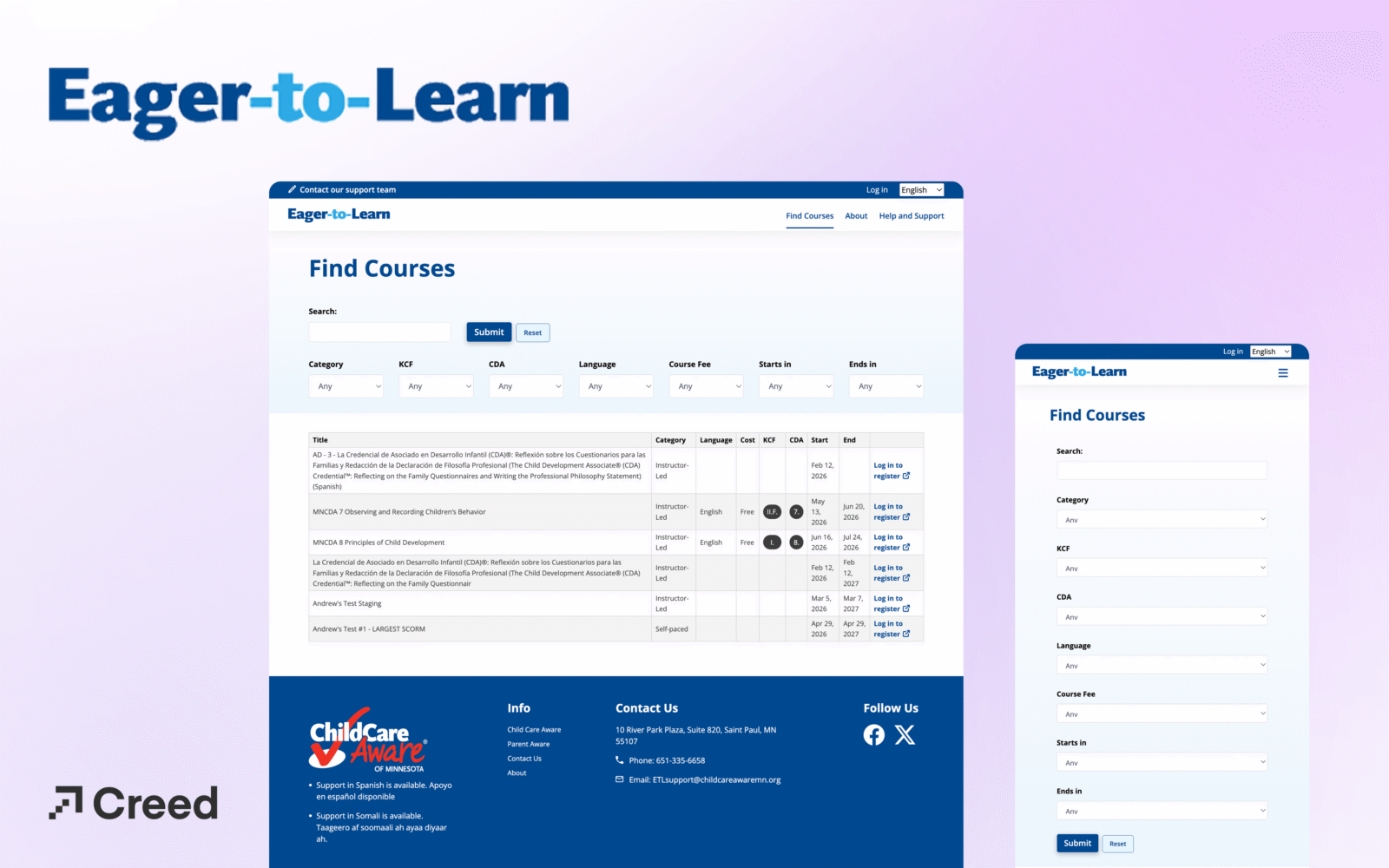
Eager-To-Learn (ETL) supports early childhood professionals across Minnesota with training, resources, and certification pathways that are critical to their work. As their audience and offerings expanded, ETL reached a point where its learning platform needed to grow alongside them, both for learners navigating courses and for administrators managing content behind the scenes.
Creed partnered with ETL to rethink the experience from the ground up, designing and building a more intuitive, scalable platform on Moodle. This included managing a high volume of course data, supporting learners actively engaged in training, and maintaining critical integrations, while shaping a system that reflects the real needs of both learners and administrators.
The challenge
ETL’s Learning Management System needed to handle increasing complexity across users, content, and operations. Challenges included:
- Limited flexibility to support evolving training and certification needs
- A dated user experience that made it harder for learners to find and complete courses
- Administrative workflows slowed by system complexity
- Complex data and system dependencies, including an existing integration with Develop, a tool supported by Minnesota’s Department of Children, Youth & Families (DCYF)
- Strain on administrative resources due to volume of support calls and tickets, rather than self-service
At the same time, ETL needed to maintain a stable experience for existing users and active courses while meeting the expectations of key stakeholders and funders.
Discovery, strategy, and platform selection
The project began with a robust discovery phase to ensure the right long-term solution, not just a visual refresh.
Creed worked closely with ETL to evaluate LMS platform options, conduct user research and stakeholder interviews, document requirements, and align technical recommendations with operational realities.
Through this process, Moodle emerged as the best foundation due to its flexibility and scalability. It provides native support for courses, assignments, discussions, quizzes, dashboards, and completion tracking, while allowing for custom development to support ETL’s reporting, notifications, and workflows. It also reduced reliance on third-party plugins and aligned with ETL’s existing Google Cloud Platform infrastructure.
By pairing Moodle with targeted custom development and a branded theme, ETL gained a platform that meets current needs and can adapt over time.
Designing for real users
With a clear direction in place, Creed set out to design an experience that felt intuitive for learners and manageable for the ETL team behind the scenes.
Key design priorities included:
- Simplifying how learners discover and enroll in courses
- Creating clear pathways for different user types
- Supporting accessibility and usability best practices
- Designing flexible templates that ETL staff could manage independently
User testing helped validate the approach, and those insights quickly turned into improvements, many of which were implemented before launch to better reflect how people actually use the platform and reduce the need for support.
Building the platform and navigating complexity
To bring the new platform to life, the team focused on a few key areas:
The rebuild included:
- Custom Moodle development
- Integration with Develop to maintain critical reporting and data flows
- Data migration planning for courses and users
- Iterative testing and refinement with stakeholders
Data migration, a core component of the project scope, proved to be one of the most complex aspects of the work. From discovery, the team understood that ETL’s large volume of course data, combined with users actively participating in courses, would require careful planning around timing, structure, and system behavior.
Discovery indicated that new courses would be best rebuilt directly in Moodle, while historical user data would be migrated separately.
As work progressed, legacy data required extensive testing and validation. Within the scope of the project, ETL chose to manually rebuild course content rather than rely on automated migration. While this meant some migration work would not be used, it ensured stronger long-term data quality and confidence in the new system. User data migration remains part of the final launch process.
In parallel, Moodle was customized to support ETL’s specific workflows and content structure, requiring thorough QA to ensure the platform functioned reliably for both learners and administrators.
This decision reflects a key reality of large-scale platform rebuilds: flexibility and collaboration are essential when real-world data doesn’t behave as expected.
Training & launch planning
To support a smooth transition, Creed provided:
- Admin training documentation
- Ongoing guidance during content loading
- A detailed launch plan covering final migration, testing, and go-live
As the project nears completion, remaining work includes final content entry by ETL, user data migration, and coordinated launch activities.
The outcome
The new platform provides:
- A clearer, more user-friendly learning experience for early childhood professionals
- A scalable Moodle foundation for future growth
- More flexible administrative workflows
- Alignment with stakeholder and funder requirements
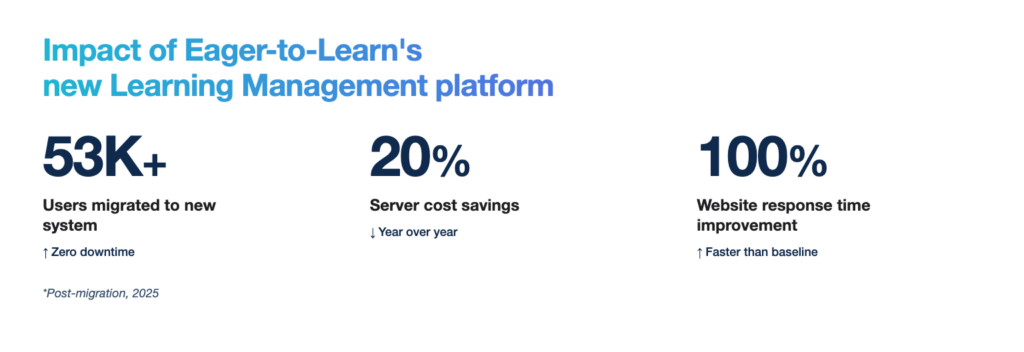
“The Creed team did a great job of making what initially felt like a daunting project more manageable, from the beginning discovery phase all the way through launch. It was clear from the start that Creed wanted to meet the needs not only of our end-users but also of our admin team, and we appreciate the creative problem-solving they brought to the table while working within the specific parameters set for us as a government-contracted non-profit organization.” – Michaela Banczak, Eager-to-Learn Program Manager
Looking ahead
Following launch, ETL has identified post-launch enhancements based on Discovery and user testing, creating a clear roadmap for continued iteration and improvement over the coming year.
The Eager-To-Learn platform reflects a thoughtful balance of strategy, design, and technical execution built to support how the organization works today and how it will grow in the future.
If you’re navigating a complex LMS rebuild, or trying to align technology with how your organization actually works, we’d love to talk.